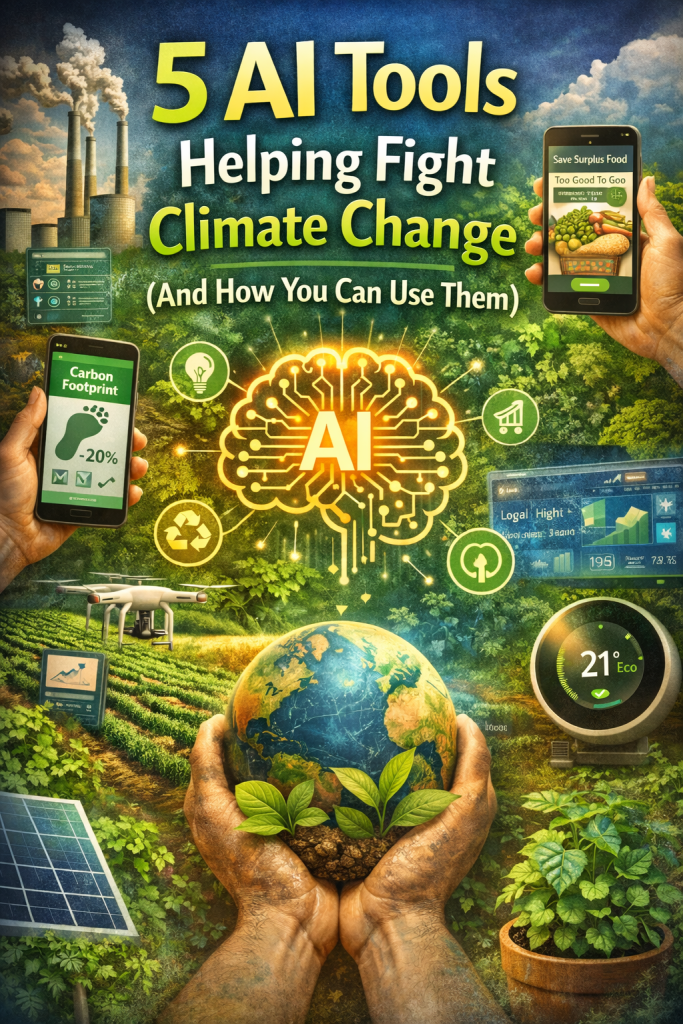
Climate change is one of the biggest challenges of our time. Governments, scientists, and communities around the world are searching for innovative solutions to reduce emissions and protect the planet.
One powerful tool emerging in this fight is Artificial Intelligence (AI).
AI can analyze huge amounts of data, detect patterns humans might miss, and help organizations make smarter environmental decisions. But AI isn’t only useful for large corporations or governments — individuals can also benefit from these tools.
Here are five AI-powered tools that are helping people and organizations take meaningful climate action.
1. AI for Tracking Carbon Footprints
Understanding your carbon footprint is the first step toward reducing it.
Apps like Joro use AI to analyze spending patterns and estimate the environmental impact of everyday purchases.
These tools can show you:
• how your travel affects emissions
• the impact of your shopping habits
• which lifestyle changes could reduce your footprint
By visualizing this data, people can make more informed and climate-friendly decisions.
2. AI for Reducing Food Waste
Food waste contributes significantly to global greenhouse gas emissions. When food ends up in landfills, it produces methane — a powerful greenhouse gas.
Platforms like Too Good To Go use smart algorithms to connect customers with restaurants and shops that have surplus food.
Instead of being thrown away, this food is sold at reduced prices.
The benefits are simple:
• consumers save money
• businesses reduce waste
• fewer emissions from discarded food
3. AI for Smarter Energy Use at Home
Energy consumption in homes accounts for a large portion of global emissions.
Smart home technologies powered by AI can automatically optimize heating, cooling, and electricity usage.
Devices like the Google Nest Thermostat learn your daily routines and adjust energy usage accordingly.
This helps households:
• lower electricity bills
• reduce carbon emissions
• maintain comfortable living environments
4. AI for Sustainable Agriculture
Agriculture plays a crucial role in global food security, but it can also be resource intensive.
AI tools are now helping farmers monitor crops, soil conditions, and weather patterns more accurately.
Organizations such as Microsoft have developed AI systems that help farmers improve yields while reducing water and fertilizer usage.
This type of innovation is essential for building a more resilient and sustainable food system.
5. AI for Climate Research and Environmental Monitoring
AI is also helping scientists better understand climate change itself.
Researchers use machine learning to analyze satellite imagery, track deforestation, and monitor ocean temperatures.
Organizations like NASA rely on AI models to process massive datasets and improve climate predictions.
This information helps policymakers and environmental groups design more effective climate strategies.
🌱 Why AI Matters for Sustainable Living
AI is not a magic solution to climate change, but it can be a powerful tool when combined with responsible policies and everyday action.
By helping people:
• understand their environmental impact
• reduce waste
• optimize energy use
• make better consumption choices
AI can support the transition toward a more sustainable future.
🌿 The Mission of EcoAIHub
At EcoAIHub, we explore how technology and sustainability can work together.
Our goal is to share practical ideas, tools, and strategies that help individuals make smarter choices for both their lives and the planet.
Because the future of sustainability will not rely only on innovation — it will depend on how we choose to use that innovation.
 Eco-AI Hub